

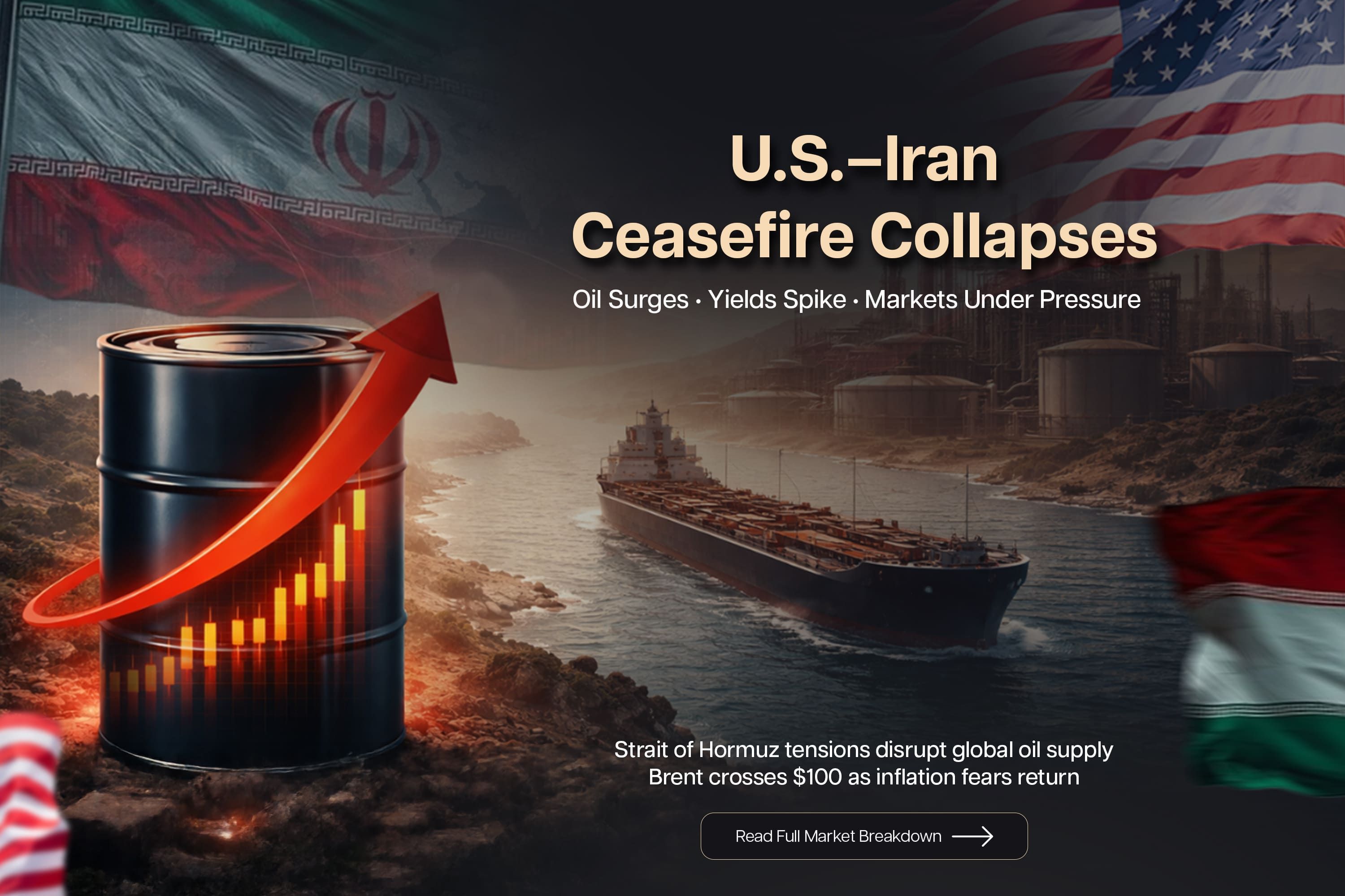
Global financial markets have entered the week under pressure as escalating tensions in the Middle East drive volatility across commodities, bonds, and currencies.
The collapse of U.S.–Iran peace talks has intensified geopolitical risk, with Donald Trump announcing plans to impose a blockade targeting Iranian maritime activity. This development has renewed concerns of a prolonged energy disruption, with the Strait of Hormuz once again at the center of global focus.
As a critical route for a significant portion of the world’s oil supply, any disruption in this region has immediate and far-reaching consequences.
Oil markets reacted sharply. Brent Crude surged nearly 8% to trade above $104 per barrel, marking a gain of over 40% since the conflict began. The rapid increase in energy prices has reignited inflation concerns and triggered a broad repricing across financial markets.
Government bond yields moved higher globally, reflecting rising inflation expectations. U.S. 10-year Treasury yields climbed to 4.33%, while Germany’s Bund reached 3.058% and Italy’s 10-year yield rose to 3.853%. This synchronized movement signals a shift in market expectations toward tighter financial conditions.
Equity markets, meanwhile, moved lower. European indices such as the STOXX 600 declined, while U.S. equity futures also traded in the red. At the same time, the U.S. dollar strengthened, and the euro weakened, highlighting a classic risk-off environment.
The combination of rising energy prices and slowing growth expectations has brought back concerns of stagflation — a scenario where inflation remains elevated while economic growth weakens.
This presents a growing challenge for major central banks, including the Federal Reserve, European Central Bank, and Bank of England. Markets are now assigning a lower probability to near-term rate cuts, as policymakers may be forced to prioritize inflation control over growth support.
Geopolitical risks remain elevated, with ongoing enforcement measures from the U.S. and continued diplomatic efforts from global leaders aimed at de-escalation and restoring stability in key shipping routes.
For now, markets are navigating a fragile balance between geopolitical escalation, energy supply shocks, and tightening financial conditions. The resurgence of inflationary pressure alongside weakening growth reinforces a familiar reality:
Geopolitics has once again become the dominant driver of global market direction.